
 English
 Russian
 French
 Spanish
 Portuguese
 Arabic
 Korean
 Vietnamese
 Turkish
-
ABOUT US >
Company Profile Factory Display Equipment Display Privacy Statement Terms&Conditions
-
NEWS >
FOLLOW US
Contact us and you will find out more about us.



Choosing the right tube mill size is an important step when planning a scaffolding pipe manufacturing project. The selected production line needs to match the required pipe diameters, wall thicknesses, steel materials, and production capacity.
For manufacturers producing popular steel scaffolding pipes and galvanized scaffolding tubes, KINGTECH offers several high frequency welded tube mill options, including HF32 tube mill, HF50 tube mill, HF50K102 tube mill, HF76 tube mill, and HF89 tube mill.
These models can be considered for different production requirements, from smaller scaffolding tubes to larger-diameter steel pipes. The most suitable scaffolding tube mill depends on your target product specifications and future production plans.
There is no single tube mill size suitable for every scaffolding pipe manufacturer. Different factories produce different pipe diameters, wall thicknesses, and product ranges.
As a starting point, KINGTECH recommends the following models according to the general scale of the intended scaffolding pipe production project.
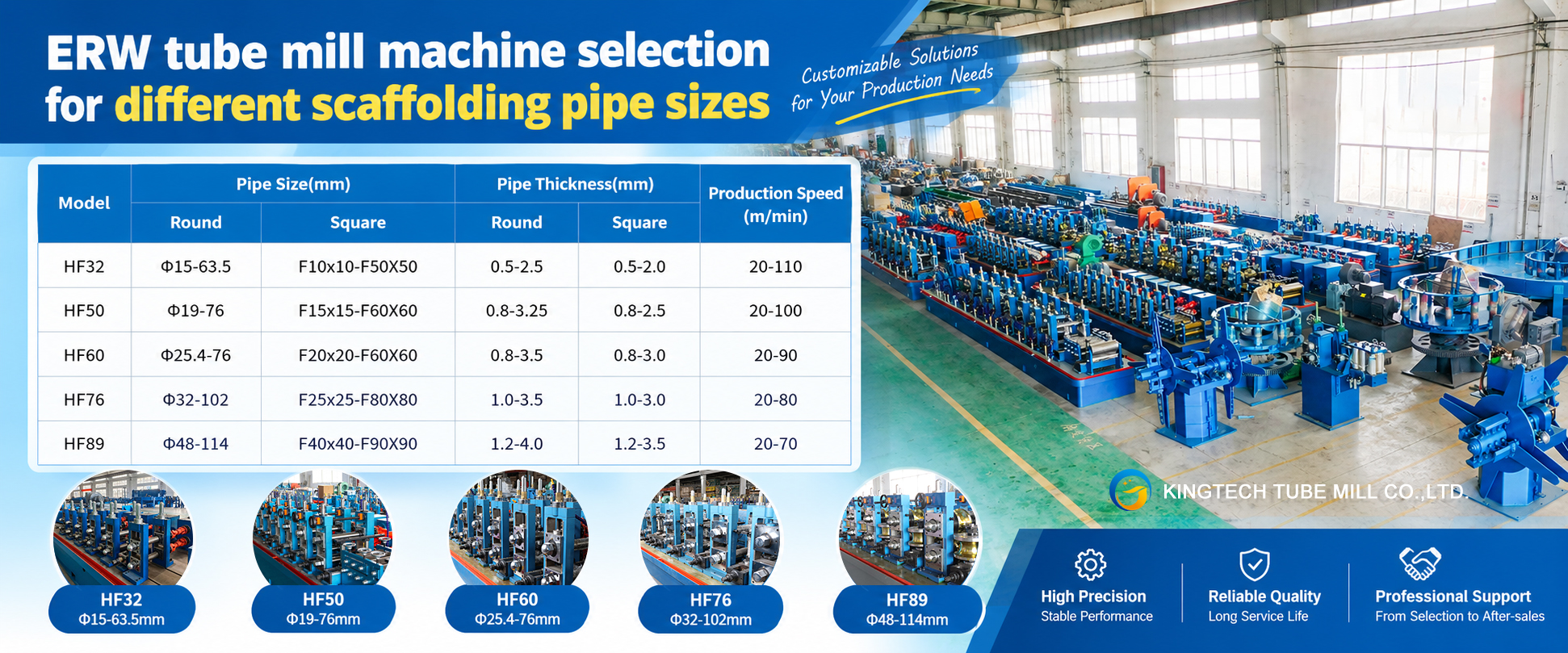
This classification is a preliminary equipment selection guide rather than a strict industry standard. The final model should be confirmed according to the required outside diameter range, wall thickness, material, tooling configuration, and production targets.
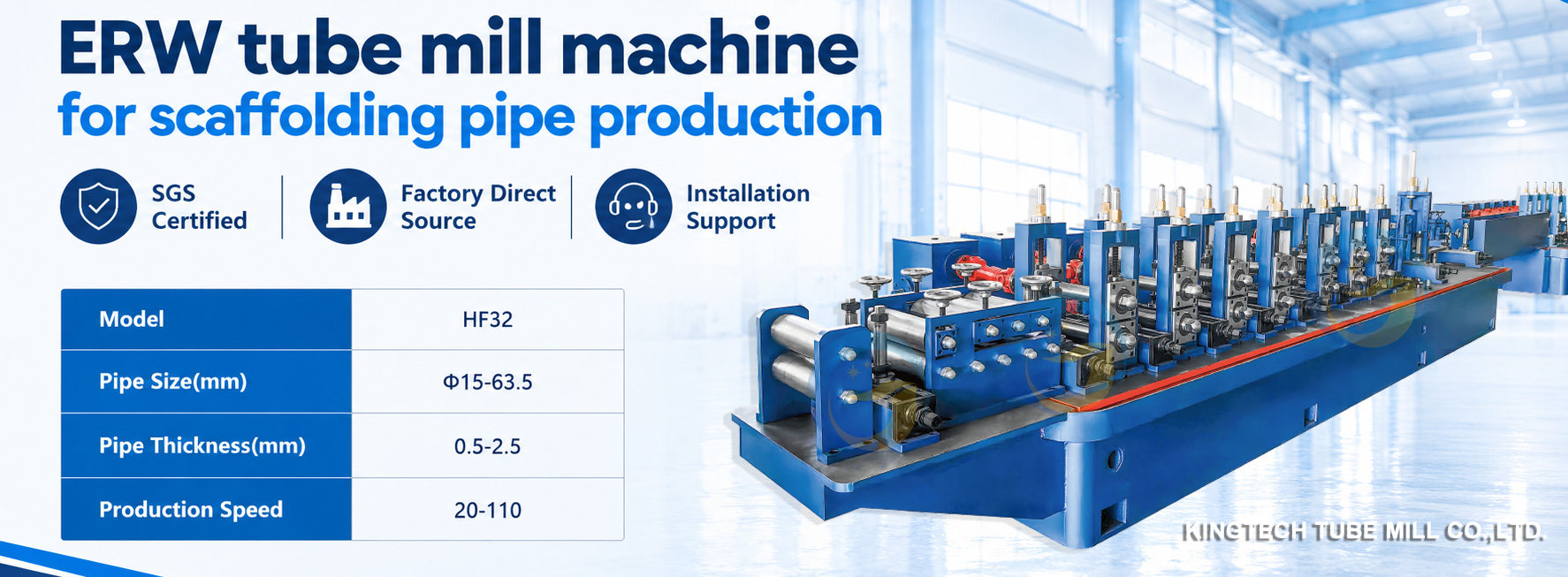
The HF32 high frequency welded tube mill is a potential option for manufacturers focusing on smaller-diameter steel pipes.
It is worth considering for factories that want to establish or expand a production line for a relatively concentrated range of smaller tube sizes.
Recommended for:
Manufacturers producing smaller-size scaffolding tubes
Factories with a defined range of small-diameter steel pipes
Businesses planning to enter the scaffolding pipe market
Before selecting HF32, confirm that its actual production range covers your target pipe diameters and wall thicknesses.
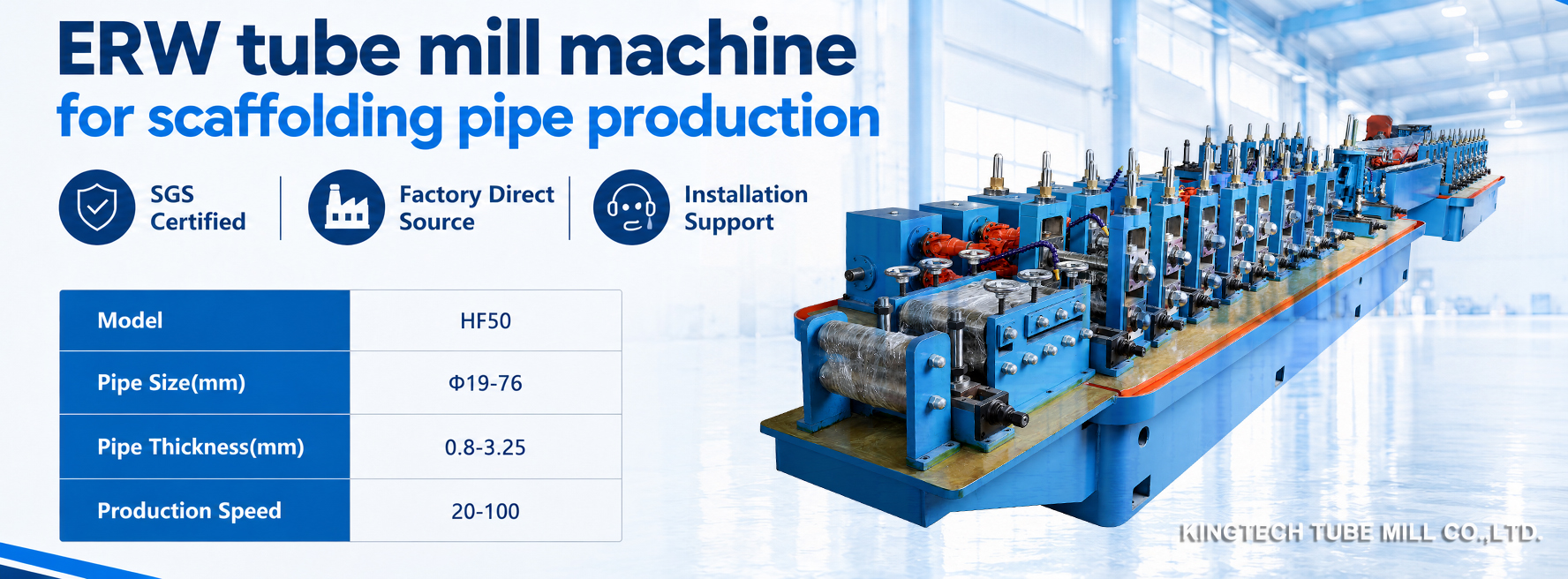
For manufacturers producing medium-size scaffolding pipes or requiring greater flexibility in their product range, HF50 and HF50K102 are models worth evaluating.
The choice between these models should be based on the required tube dimensions and the range of products you plan to manufacture. A wider product range may require a different tooling configuration and production line setup.
Recommended for:
Manufacturers producing medium-size scaffolding steel pipes
Existing pipe factories expanding their product range
Businesses manufacturing multiple tube specifications
When comparing HF50 and HF50K102, review the available pipe diameter range, wall thickness capability, changeover requirements, and expected output.
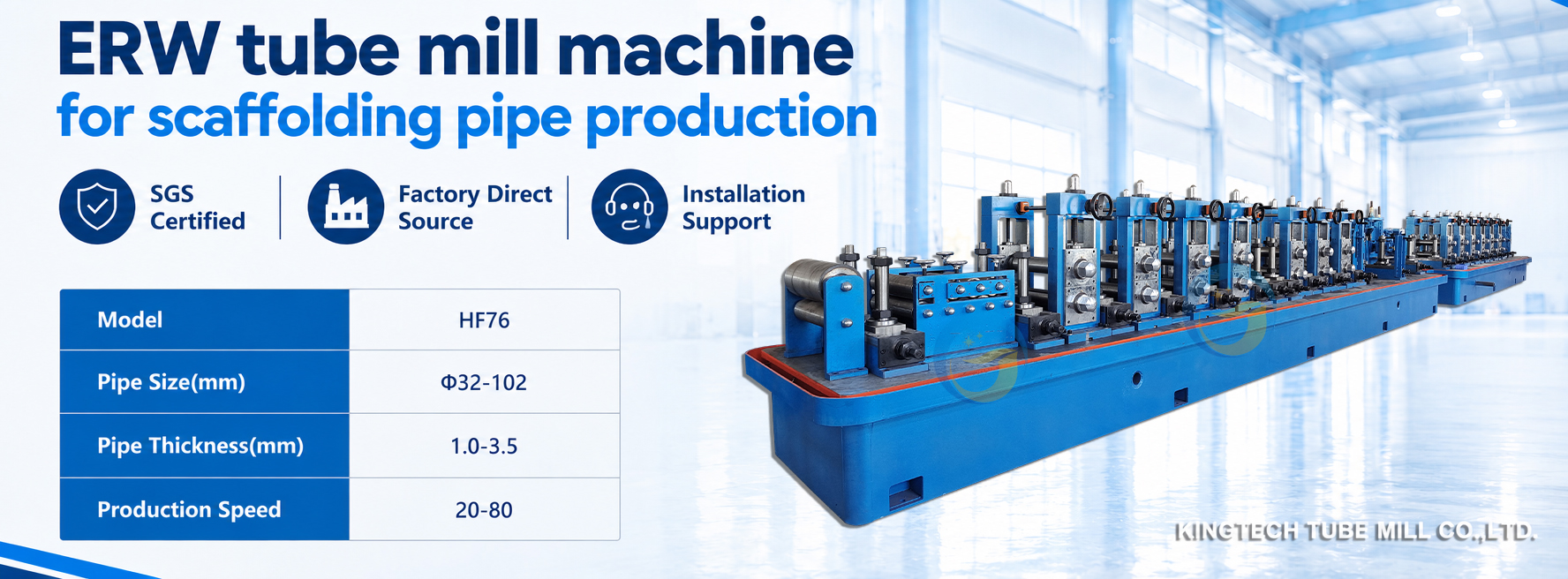
Manufacturers planning to produce larger-diameter scaffolding pipes can consider HF76 or HF89, subject to the actual requirements of the project.
These models should be evaluated according to the maximum pipe diameter, material thickness, welding requirements, and production capacity required by the customer.
Recommended for:
Factories targeting larger-diameter steel tubes
Manufacturers expanding into additional pipe specifications
Projects requiring a production line configured for larger tube sizes
The model name alone does not determine whether a machine can produce a specific scaffolding pipe. Confirm the technical specifications and tooling configuration with the supplier before making a purchasing decision.
When comparing ERW tube mill size options, manufacturers should evaluate more than the model number.
List the minimum and maximum outside diameters you intend to produce. The selected machine must cover the full target range.
Wall thickness affects forming conditions, welding requirements, tooling selection, and production speed. Confirm the actual thickness range for each intended pipe size.
Specify whether the line will process carbon steel strip, pre-galvanized steel strip, or other materials. Material properties can influence production settings and equipment configuration.
If you plan to manufacture different pipe sizes on one line, ask which sizes can be produced with the selected machine and what tooling changes are required.
Define your expected output and operating schedule. Actual production capacity depends on the tube specifications, material, line speed, changeover time, and operating conditions.
If you expect to expand into larger pipe sizes or additional products, consider your future requirements before choosing a model. Selecting a machine around a realistic long-term product range can help avoid unnecessary equipment changes later.
KINGTECH provides high frequency welded tube mill solutions for steel pipe manufacturers serving scaffolding and other industrial applications.
For scaffolding pipe production, HF32, HF50, HF50K102, HF76, and HF89 are model options that can be evaluated according to the customer's intended product range.
Our equipment selection process considers the required pipe diameters, wall thicknesses, raw materials, production targets, tooling requirements, and factory conditions.
To help identify a suitable scaffolding tube mill, please provide the following information:
Minimum and maximum pipe outside diameters
Required wall thickness range
Carbon steel or galvanized steel strip
Finished pipe lengths
Target production capacity
Current product range and planned future expansion
With these details, the appropriate machine model and production line configuration can be evaluated for your project.
Selecting the right tube mill size is essential for efficient scaffolding pipe production. HF32, HF50, HF50K102, HF76, and HF89 offer different options to evaluate according to smaller, medium, and larger scaffolding pipe production requirements.
Rather than selecting a machine based on its model number alone, confirm the required pipe dimensions, material, production targets, and tooling configuration.
Contact KINGTECH to discuss your scaffolding pipe production requirements and identify a suitable high frequency welded tube mill for your factory.

Company Profile Factory Display Equipment Display Privacy Statement Terms&Conditions
Contact us and you will find out more about us.