
 English
 Russian
 French
 Spanish
 Portuguese
 Arabic
 Korean
 Vietnamese
 Turkish
-
ABOUT US >
Company Profile Factory Display Equipment Display Privacy Statement Terms&Conditions
-
NEWS >
FOLLOW US
Contact us and you will find out more about us.



Scaffolding pipes are widely used in construction and infrastructure projects where reliable, strong, and cost-effective steel tubes are required. As more construction projects replace traditional bamboo scaffolding with steel and galvanized pipes, the demand for efficient scaffolding pipe production equipment continues to grow.
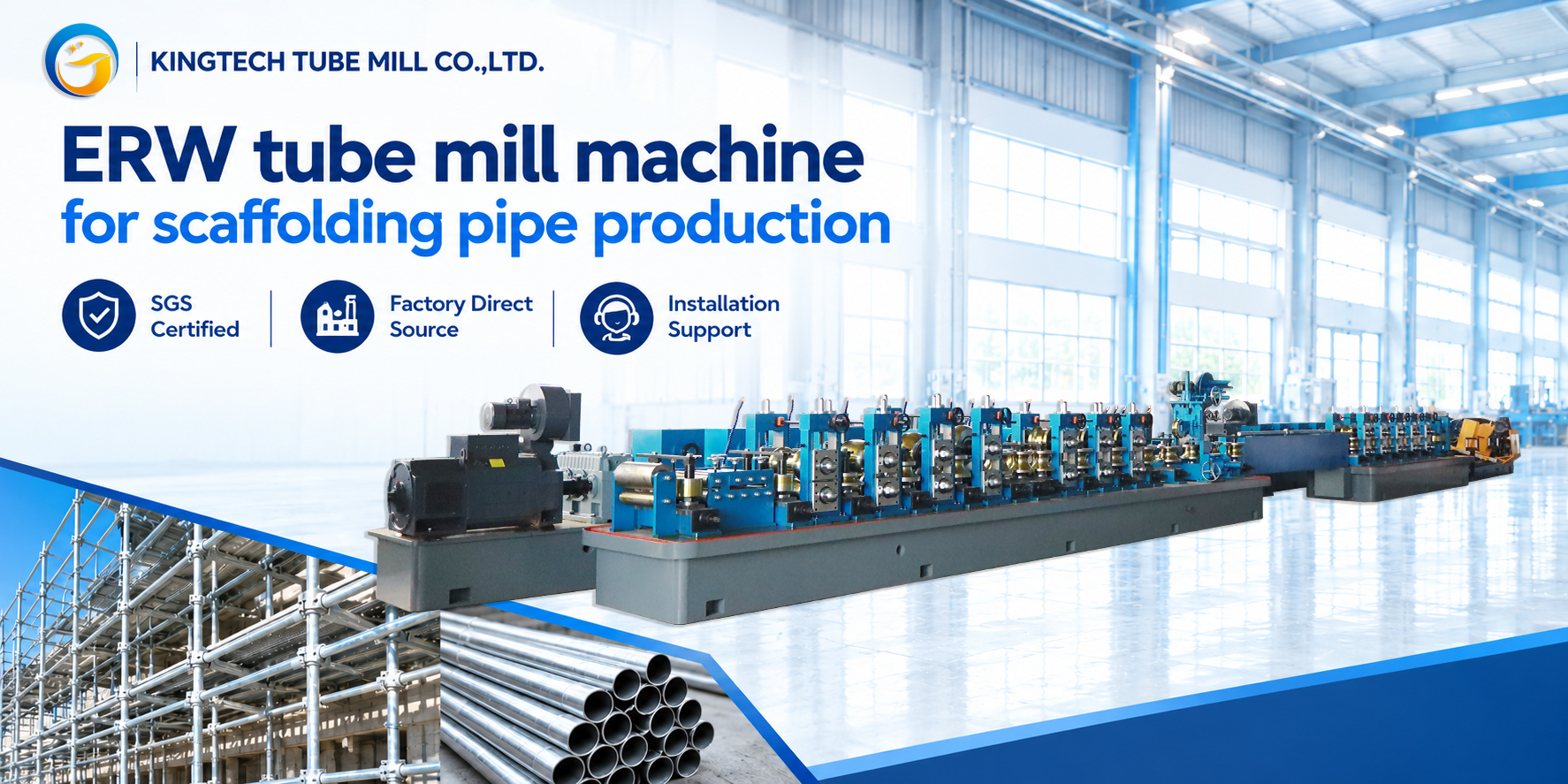
For manufacturers planning to produce scaffolding pipes, choosing the right ERW Tube Mill Machine is an important decision. The suitable machine depends not only on pipe diameter and wall thickness, but also on production capacity, material, factory conditions, and future expansion plans.
Scaffolding pipes are steel tubes commonly used to build temporary supporting structures for construction and maintenance work. They are valued for their strength, durability, dimensional accuracy, and ability to withstand repeated use.
Typical applications include:
Construction scaffolding
Building projects
Temporary structures
Industrial maintenance
Infrastructure projects
Scaffolding pipes are commonly manufactured from carbon steel or iron materials. For this type of application, ERW high frequency welding is widely used because it offers high production efficiency, stable welding performance, and suitability for continuous steel pipe manufacturing.
Depending on the customer's requirements, scaffolding pipes can also be produced with galvanized surfaces to improve corrosion resistance and service life.
In many traditional construction markets, bamboo was previously used for scaffolding because it was inexpensive and readily available. However, as construction standards and safety requirements continue to receive greater attention, steel scaffolding has become increasingly popular.

Compared with traditional bamboo scaffolding, steel pipes provide several advantages:
Higher Structural Strength
Steel pipes provide consistent mechanical strength and are suitable for supporting construction workers, materials, and temporary structures.
Better Dimensional Consistency
Steel tubes produced by an ERW tube mill can maintain consistent diameter, wall thickness, and shape, which is important when connecting multiple scaffolding components.
Longer Service Life
Steel and galvanized pipes can be reused many times when properly maintained, making them suitable for professional construction companies and rental businesses.
Suitable for Large Construction Projects
As construction projects become larger and more standardized, steel scaffolding provides a more scalable solution for contractors and infrastructure companies.
For these reasons, steel and galvanized scaffolding pipes are becoming increasingly common in many developing construction markets.
There is no single tube mill that is suitable for every scaffolding pipe manufacturer. The recommended machine depends on the pipe diameter, wall thickness, material, and required production capacity.
Based on different scaffolding pipe sizes, we commonly recommend the following ERW tube mill models.
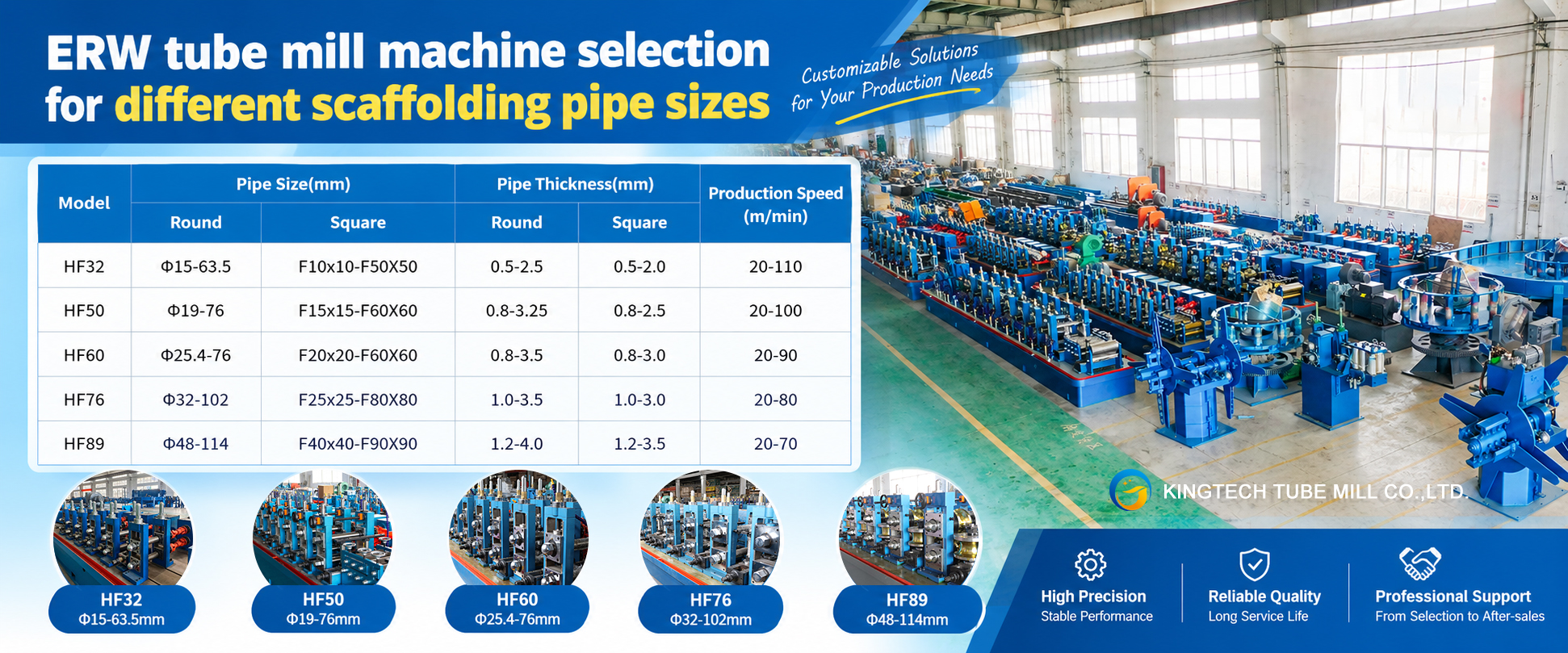
Small Size Scaffolding Pipes
For customers producing smaller diameter scaffolding or construction pipes, the HF32 ERW Tube Mill Machine can be a suitable choice.
It is designed for relatively small pipe sizes and can provide an efficient solution for manufacturers targeting small and medium-scale production.
Medium Size Scaffolding Pipes
For medium diameter scaffolding pipes, we recommend models such as HF50 and HF50K102 ERW Tube Mill Machine.
These machines can be configured according to the customer's required pipe diameter, wall thickness, production speed, and material.
The HF50K102, for example, can be configured for pipe production in the range of approximately 50.8–102 mm diameter, depending on the final machine configuration.
Large Size Scaffolding Pipes
For manufacturers targeting larger diameter scaffolding and construction pipes, models such as HF76 Tube Mill and HF89 Tube Mill can provide a better production solution.
The larger tube mill configuration allows manufacturers to cover a wider range of pipe sizes and expand their product portfolio.
The right tube mill is not only determined by pipe size. Production capacity is equally important.
Two customers may produce the same scaffolding pipe size but require completely different production capacities.
For example:
A small pipe manufacturer may need one tube mill for its target output.
A medium-sized factory may need two or more tube mills to meet customer demand.
A large steel pipe manufacturer may need multiple production lines operating simultaneously.
Therefore, machine selection should consider both pipe specifications and production targets.
Before selecting an ERW Tube Mill Machine, manufacturers should evaluate:
Pipe diameter
Wall thickness
Steel material
Required tons per month
Number of pipe sizes
Required production speed
Available factory space
Future production expansion
This approach helps manufacturers avoid choosing a machine that is either too small for their production target or unnecessarily large for their current market.
Choosing a tube mill becomes easier when manufacturers can refer to real production projects. Our previous projects in different countries show how machine selection can be adapted to different market conditions and production requirements.
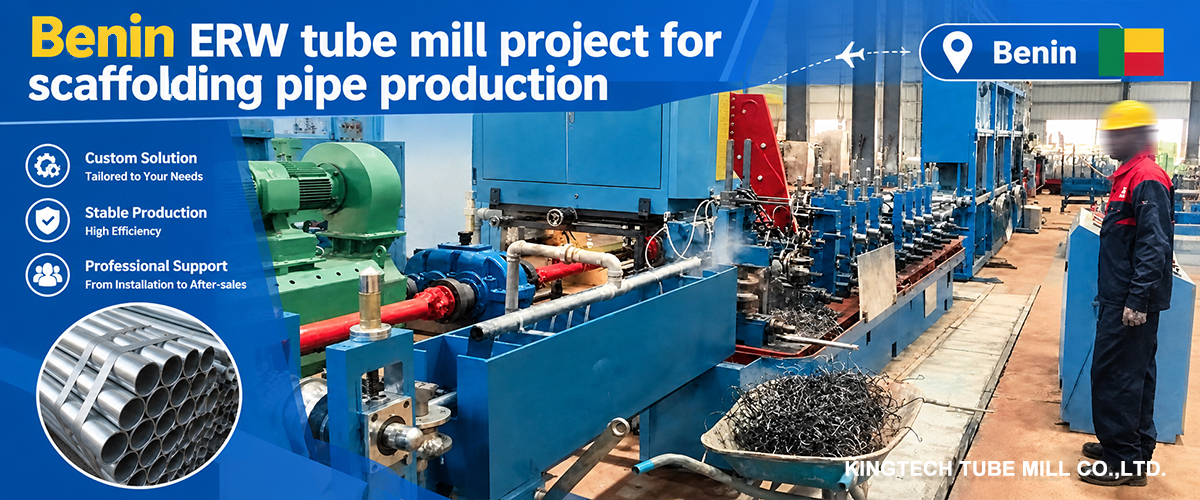
The Benin customer originally did not have a steel pipe factory. Before purchasing equipment, the customer wanted to understand the local market and determine which pipe products had the greatest potential.
Based on the market analysis and target applications, we recommended HF32 and HF45 ERW Tube Mill Machines for scaffolding and construction pipe production.
The project included more than simply supplying machines. We provided a complete solution covering investment planning, factory layout, equipment selection, installation, commissioning, and operator training.
The customer later expanded the factory by adding an HF28 tube mill in 2025.
Today, the factory has reached approximately 1,500–2,000 tons of monthly production.
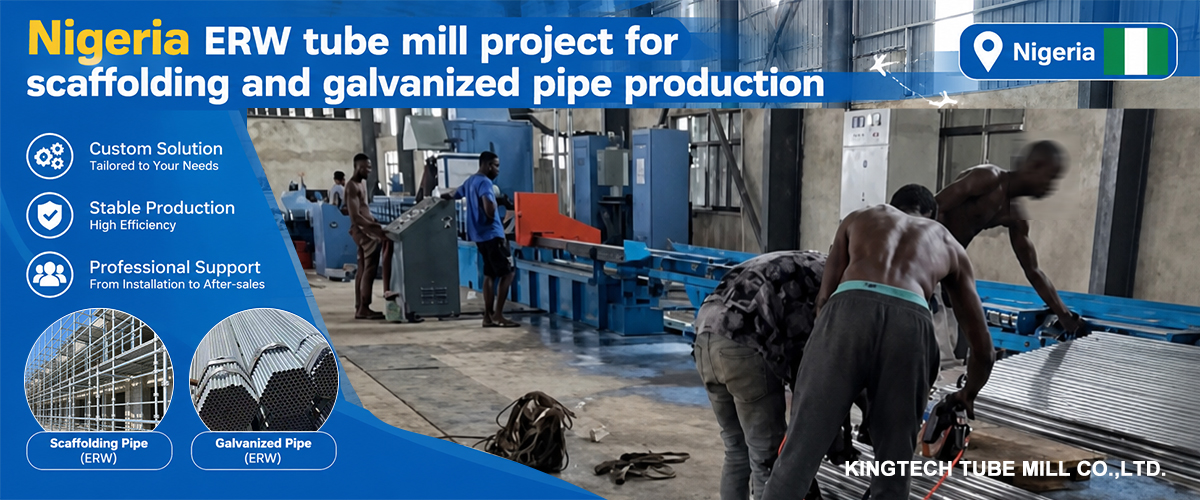
The Nigerian customer originally operated in the garment accessories business. After identifying an opportunity in the local steel pipe market, the customer planned to enter steel pipe manufacturing.
The target products included iron pipes and galvanized pipes for scaffolding and construction applications.
Based on the customer's product requirements and production plans, we recommended HF28 and HF50K102 ERW Tube Mill Machines.
The machines were installed and commissioned in 2026, and the factory is now in production.
The current production capacity is approximately 1,500 tons per month.
This project demonstrates how a customer from another industry can enter the steel pipe business with the right equipment selection and production planning.
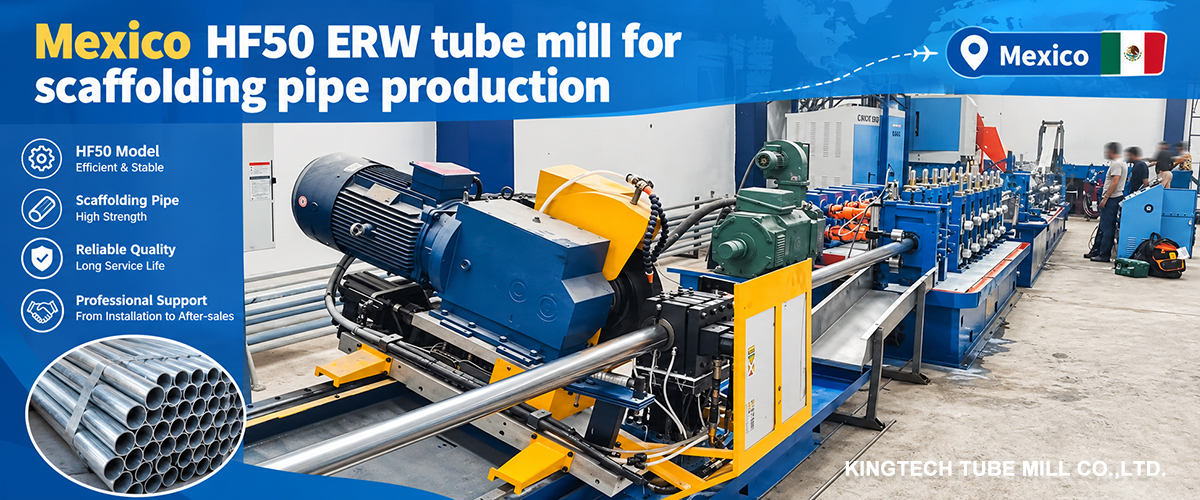
The Mexican customer was already operating a steel pipe factory and needed additional tube mill capacity to expand production.
The customer produces scaffolding and construction pipes and selected an HF50 ERW Tube Mill Machine for the additional production line.
Unlike a new factory project, this type of project focuses on expanding existing production capacity while maintaining stable manufacturing performance.
The machine was customized according to the customer's pipe specifications and production requirements.
If you are planning to manufacture scaffolding pipes, we recommend evaluating your project from four key aspects.
1. Pipe Specifications
Provide the required pipe diameter and wall thickness. These specifications are the starting point for selecting the appropriate tube mill model.
2. Production Capacity
Tell us your expected production target, such as tons per month or tons per year.
Production capacity can affect the number of tube mills required, production speed, and overall line configuration.
3. Material and Surface Requirements
Tell us whether you plan to produce carbon steel, iron, or galvanized pipes.
Different materials and finishing requirements may require different equipment configurations.
4. Future Expansion
If you expect demand to increase in the future, it is important to consider your expansion plans when selecting the initial equipment.
A suitable tube mill solution should not only meet today's production requirements but also provide room for future growth.
Choosing the right ERW Tube Mill Machine requires more than simply comparing machine models.
Please tell us your:
Pipe material
Pipe diameter
Wall thickness
Production capacity
Required pipe sizes
Factory and expansion requirements
Our engineering team will recommend the suitable ERW Tube Mill Machine and production line configuration based on your requirements.
From machine selection and factory planning to manufacturing, installation, commissioning, and operator training, we can provide a complete solution for your scaffolding pipe production project.
Contact us to discuss your scaffolding pipe production requirements and get a customized tube mill solution.

Prev : none
Company Profile Factory Display Equipment Display Privacy Statement Terms&Conditions
Contact us and you will find out more about us.