
 English
 Russian
 French
 Spanish
 Portuguese
 Arabic
 Korean
 Vietnamese
 Turkish
-
ABOUT US >
Company Profile Factory Display Equipment Display Privacy Statement Terms&Conditions
-
NEWS >
FOLLOW US
Contact us and you will find out more about us.



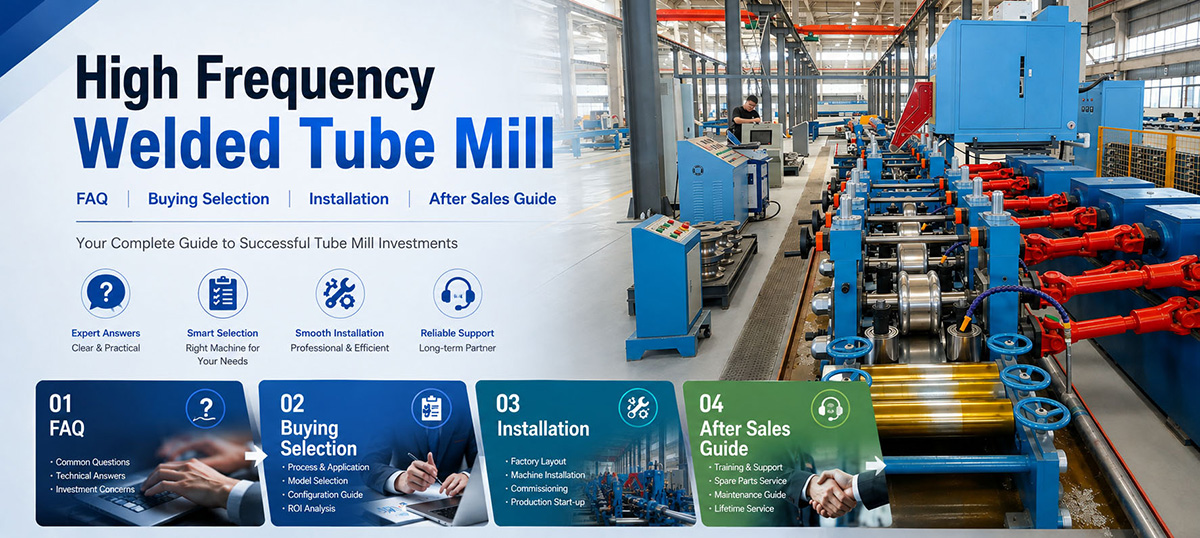
A1: A high frequency welded tube mill is a production line used to manufacture welded steel tubes and pipes from steel strip coils.
The steel strip is uncoiled, leveled, formed into a tube, welded by high-frequency induction, sized and straightened, and then cut into required lengths.
A2: Depending on the machine configuration, one tube mill can produce:
Round pipes
Square pipes
Rectangular pipes
Oval pipes
Decorative Pipes
Industrial Pipes
The final pipe size and shape depend on the selected forming and sizing tooling.
The final pipe applications depend on the equipment configuration and manufacturing process.
A3: Common materials include:
Carbon steel
Mild steel
Cold-rolled steel
Hot-rolled steel
Galvanized steel
For stainless steel production, a dedicated stainless steel tube mill is normally recommended because the forming, welding and tooling requirements are different.
A4: The production range depends on the specific tube mill model.
For example:
HF50 Model
Round Tube: Ø19–Ø76 mm
Square Tube: 15×15–60×60 mm
These figures are only examples. The actual range should be confirmed according to the customer's required pipe sizes and wall thickness.
A5: A typical high-frequency welded tube production line includes:
Steel Strip Coil → Coil Loading → Strip Cutting & Butt Welding → Accumulator → Strip Feeding & Forming → High-Frequency Welding → External Weld Bead Removal → Cooling → Sizing & Straightening → Flying Saw Cutting → Pipe Discharging → Stacking & Bundling → Inspection
This is the complete process from steel coil to finished tube.
A6: A complete tube mill line may include:
Uncoiler
Leveling machine
Strip shear & butt welder
Accumulator
Forming mill
High-frequency welding machine
Cooling system
Sizing mill
Flying saw
Run-out table
The exact configuration can be customized.
A7: The machine should be selected according to the customer's:
Minimum pipe diameter
Maximum pipe diameter
Maximum wall thickness
Steel material
Pipe shapes
Required production capacity
Required production speed
Finished pipe length
The customer's pipe size range is the most important information for machine selection.
A8: Yes.
Many tube mills can produce round, square and rectangular tubes by changing the tooling .
However, the compatible size range depends on the machine model.
A9: The price depends heavily on:
Machine size
Pipe diameter range
Wall thickness
Production speed
HF power
Automation level
Cutting system
Tooling
Auxiliary equipment
Therefore, a reliable quotation normally requires the customer's pipe size, wall thickness, material and required capacity.
A10: Production capacity is normally calculated based on tons per month or meters per minute.
For example, a customer producing structural tubes may require (2 sets tube mills) :
1,000–1,500 tons/month
When quoting a machine, it is better to calculate capacity based on:
Pipe size + wall thickness + working hours/day + working days/month + production speed.
A11: Yes.
We can provide technical support for machine installation, commissioning and operator training.
Depending on the project, engineers can also be arranged for on-site installation and commissioning.
A12: This depends on the customer's production needs; different models of pipelines require different installation dimensions.
For example, one HF 28 tube mill line requires an installation dimension of 5m x 40m. Therefore, we would recommend that the customer's factory area be no less than 10m x 40m.
A13: Installation time depends on:
Machine size
Production line configuration
Factory preparation
Electrical installation
Foundation preparation
Operator experience
A complete project schedule should be confirmed before shipment.
A14: Regular maintenance should include:
Lubrication
Roll inspection
Bearing inspection
HF system inspection
Cooling water inspection
Electrical system inspection
Welding system inspection
Saw blade inspection
Fastener inspection
Proper maintenance can improve machine stability and extend equipment service life.
A15: Yes.
Training can cover:
Machine operation
HF welding operation
Roll adjustment
Pipe size changeover
Production parameter setting
Troubleshooting
Daily maintenance
Safety procedures

Prev : none
Next : The Advantages of Using a High Frequency Welding Tube Mill
Company Profile Factory Display Equipment Display Privacy Statement Terms&Conditions
Contact us and you will find out more about us.