
 English
 Russian
 French
 Spanish
 Portuguese
 Arabic
 Korean
 Vietnamese
 Turkish
-
ABOUT US >
Company Profile Factory Display Equipment Display Privacy Statement Terms&Conditions
-
NEWS >
FOLLOW US
Contact us and you will find out more about us.



Scaffolding pipes are widely used in construction projects to support workers, materials, and temporary structures. As demand for construction equipment grows, more manufacturers are looking for efficient ways to produce steel scaffolding tubes. But what machine is used to make scaffolding pipes?
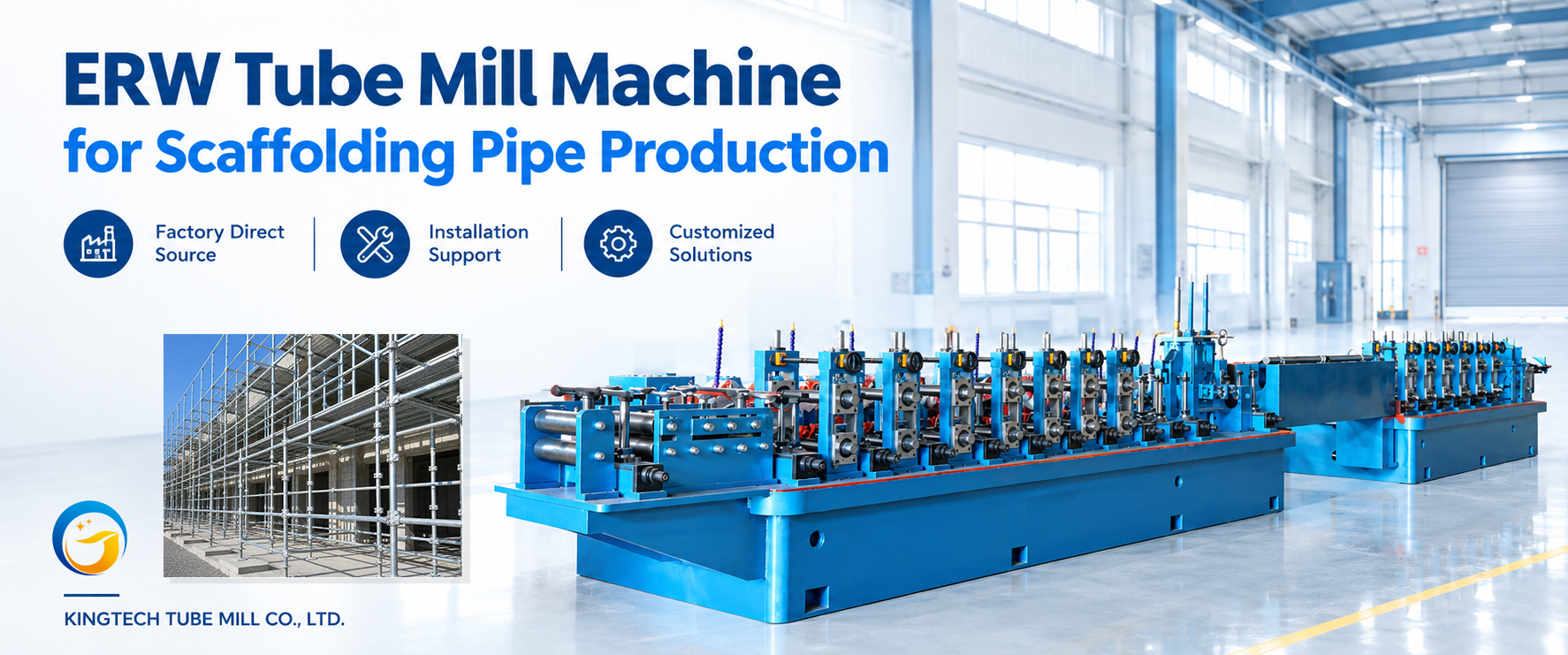
A scaffolding pipe making machine, typically a high frequency welded tube mill, is commonly used to manufacture steel pipes for scaffolding applications. It transforms steel strip coils into round steel tubes through forming, high frequency welding, sizing, and cutting processes.
For manufacturers planning to establish a new pipe factory or expand existing production capacity, choosing the right scaffolding pipe machine is an important step toward achieving consistent product quality and efficient production.
A high frequency welded tube mill is a common solution for producing welded steel scaffolding pipes. The machine processes steel strip coils continuously, forming the flat strip into a round tube and joining the edges through high frequency induction or contact welding.
After welding, the tube passes through sizing and straightening stands to achieve the required dimensions and shape. A flying saw or other suitable cutting system then cuts the continuous tube into specified lengths.
A complete scaffolding pipe production line generally includes:
Coil loading and uncoiling equipment
Strip shearing and butt welding equipment
An accumulator, depending on the production line configuration
Forming stands
A high frequency welding system
External weld bead removal equipment, where required
Cooling and sizing sections
Straightening and cutting equipment
Pipe run-out and collection equipment
The configuration depends on the target pipe diameter, wall thickness, production speed, material specifications, and factory requirements.
A scaffolding pipe making machine converts steel strip into finished steel tubes through several continuous processing stages.
Step 1: Steel Strip Feeding
Steel strip coils are loaded onto the uncoiler and fed into the production line. Strip preparation and butt welding connect successive coils, helping maintain continuous production.
Step 2: Tube Forming
A series of forming rollers gradually bends the flat steel strip into a round tubular shape. The forming section is designed according to the required pipe diameter and material thickness.
Step 3: High Frequency Welding
The edges of the formed strip are heated using a high frequency welding system and pressed together to create a longitudinal weld seam. Welding parameters must be matched to the material, wall thickness, and production speed.
Step 4: Weld Bead Removal and Cooling
Where specified, external weld bead removal equipment trims excess weld material. The welded tube is then cooled as required by the production line configuration.
Step 5: Sizing and Straightening
Sizing rollers calibrate the tube to the required outside diameter and help maintain dimensional consistency. Straightening equipment corrects the tube's alignment before cutting.
Step 6: Cutting to Length
A flying saw or another suitable cutting system cuts the continuously produced tube into the specified lengths. The finished pipes are then collected for inspection, bundling, and subsequent processing.
The final production process should be selected according to the manufacturer's product specifications and applicable scaffolding tube standards.
Scaffolding systems may use different tube specifications depending on the connection design, load requirements, construction regulations, and local market standards.
Round steel tubes are commonly used in traditional tube-and-coupler scaffolding systems. Manufacturers may produce carbon steel or galvanized steel tubes, depending on the intended application and finishing requirements.
When selecting a scaffolding pipe machine, manufacturers should consider the following factors:
Pipe diameter: The machine must cover the required range of outside diameters.
Wall thickness: The forming and welding systems must be suitable for the specified thickness.
Steel material: Material grade, strip width, and mechanical properties affect production settings.
Pipe length: Cutting equipment should meet the required finished lengths.
Surface treatment: Galvanizing or other corrosion-protection processes may be required, depending on the product specification.
Quality requirements: Weld integrity, dimensional tolerances, straightness, and material properties should meet the applicable product standards.
Not every scaffolding pipe has the same dimensions or requirements. Manufacturers should confirm their target specifications before selecting a production line.
Choosing a suitable scaffolding pipe machine involves more than comparing equipment prices. The production line should match your intended products, output targets, and factory conditions.
Production Range
Confirm the minimum and maximum pipe diameters and wall thicknesses you intend to produce. If you plan to manufacture multiple sizes, discuss the required tooling and changeover arrangements with the equipment supplier.
Production Capacity
Evaluate the required output, production speed, operating schedule, and expected product mix. Actual output depends on pipe specifications, material conditions, line configuration, and operating efficiency.
Welding System
The high frequency welding system should be selected according to the material, wall thickness, pipe diameter, and production requirements. Stable welding conditions are essential for producing consistent welded tubes.
Tooling and Changeover
If your factory needs to produce several pipe sizes, ask about the tooling configuration, changeover process, and time required to switch between specifications.
Factory Layout and After-Sales Support
Consider the available installation space, power supply, cooling water, operator training, commissioning, spare parts, and technical support. These factors can affect the time needed to bring a new production line into operation.
KINGTECH provides high frequency welded tube mill solutions for manufacturers producing steel pipes for scaffolding and other industrial applications.
The equipment configuration can be discussed according to the customer's required pipe diameter, wall thickness, material, production speed, and factory layout.
Depending on the selected model and configuration, a production line may include strip feeding, forming, high frequency welding, sizing, straightening, cutting, and finished pipe collection systems.
Whether you are planning a new scaffolding pipe factory or upgrading an existing production line, selecting equipment based on your actual product specifications can help you develop a more suitable manufacturing solution.
To discuss your project, prepare the following information:
Required pipe diameter range
Minimum and maximum wall thickness
Steel material and grade
Required pipe lengths
Target production capacity
Factory location and available installation space
With these details, the equipment configuration can be evaluated more accurately for your production needs.
A high frequency welded tube mill, also called a scaffolding pipe making machine, is commonly used to manufacture welded steel tubes for scaffolding applications.
Yes, some production lines can manufacture different pipe sizes by changing the appropriate tooling and adjusting the machine settings. The available range and changeover requirements depend on the machine model and configuration.
A suitable tube mill can process galvanized steel strip when the machine and welding process are configured for the material. Alternatively, manufacturers may produce steel tubes first and apply galvanizing as a separate downstream process. The appropriate method depends on the product specification and required coating quality.
Start by confirming the required pipe diameter, wall thickness, material, finished length, production capacity, and applicable standards. Then select a machine model and configuration that meet these requirements.
What information is needed for a scaffolding pipe machine quotation?
Provide your target pipe sizes, wall thickness range, material, expected production output, finished pipe lengths, and factory conditions. These details help the supplier recommend a suitable production line.
A high frequency welded tube mill is a widely used solution for producing steel scaffolding pipes. By combining continuous forming, high frequency welding, sizing, straightening, and cutting, the production line converts steel strip coils into finished tubes for construction applications.
The right scaffolding pipe making machine depends on your product specifications, production targets, and factory requirements. Contact KINGTECH to discuss a tube mill configuration tailored to your scaffolding pipe manufacturing project.

Company Profile Factory Display Equipment Display Privacy Statement Terms&Conditions
Contact us and you will find out more about us.